Reading, Writing, & Arithmetic... why do we only benchmark two of these?
Your writing benchmark already exists. It is in the writing your students turn in every week. LearningPulse analyzes that work against your own writing progression, for every student, within minutes. No new test.
You have probably said one of these.
"There is no DIBELS for writing."
"A writing benchmark means a scoring weekend, and by the time the scores come back, the moment has passed."
"Change the prompt and you change the results."
"I can't compare a sixth grader's writing to a ninth grader's."
All four are fair. They are true of writing tests. They are not true of the writing your students already produce. One three-page assignment across five classes is 375 pages, and that work is already sitting in Google Classroom and Canvas. The benchmark was never missing. Reading all of it, in time to act, was.
No testing window. No scoring weekend.
Start with a baseline you already have. A first-week quickwrite counts. So does any comparable piece. Typed or handwritten, uploaded or pulled from Google Classroom or Canvas.
Analyze it against your progression. Your district's writing progression or rubric, not a vendor's. Every student, not a sample, within minutes. Your team confirms how the criteria read before anything is analyzed.
See the cohort, then the growth. When the next comparable piece lands, the growth report connects it to the earlier work, student by student and grade by grade.
It adds no assessment. It sits beside your reading and math benchmarks and shows the part of the picture they cannot.
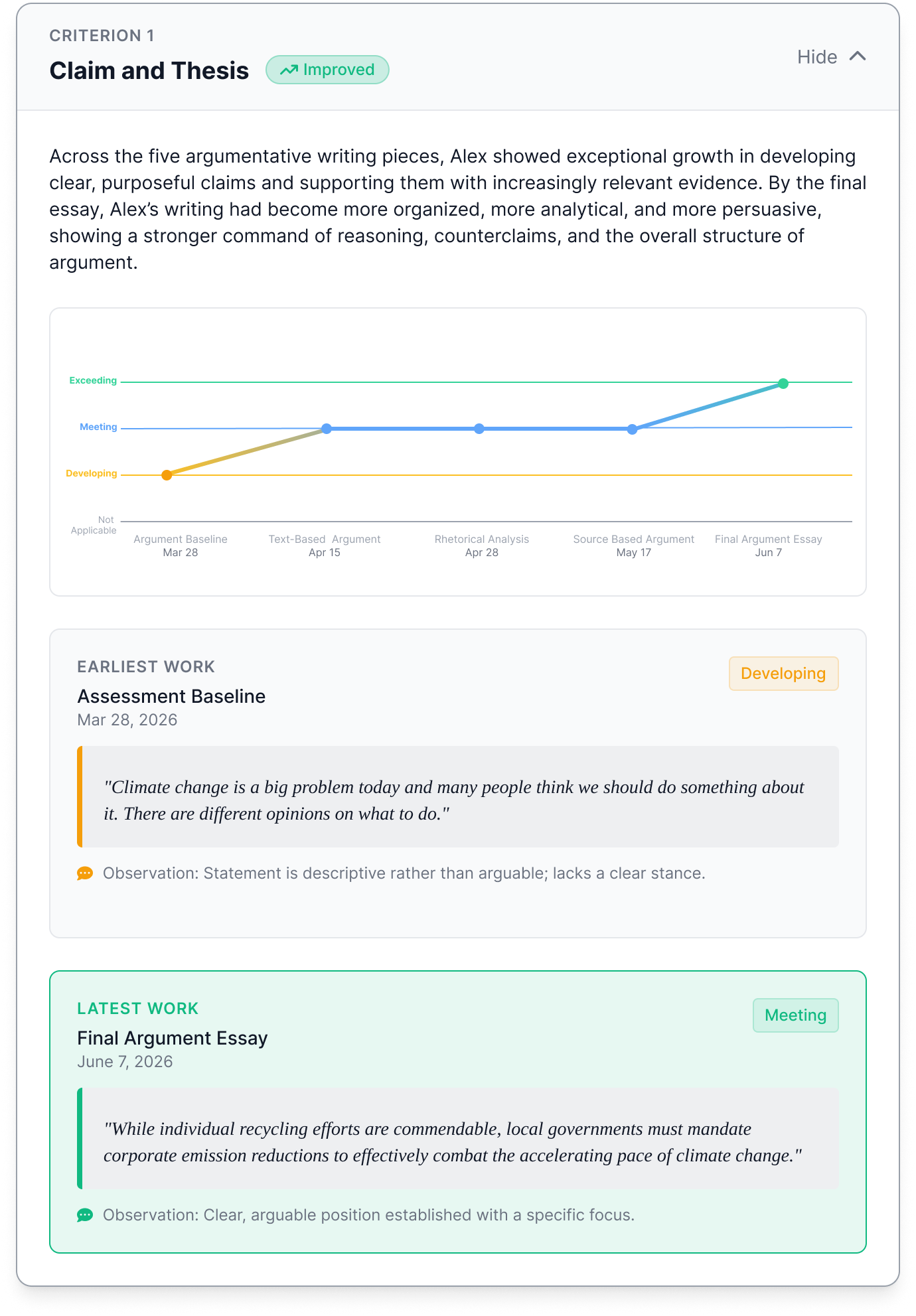
Down to the student, and how that student grew.
Every piece a student writes is read against the same expectations. Put the first piece next to the fifth and you see what changed, criterion by criterion, in the student's own words. That is growth over time, from September to December and on through June.
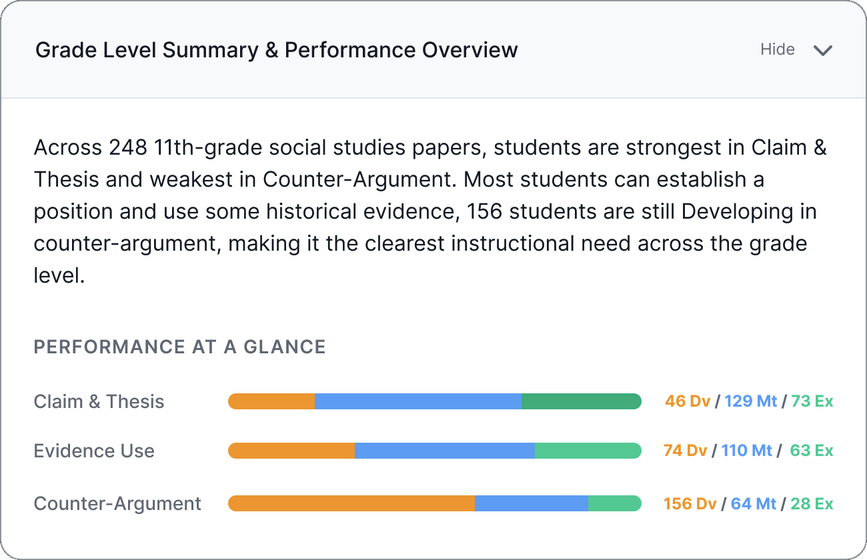
The same evidence rolls up to a classroom, a cohort, a grade level, a discipline, or the whole school: the misconception a grade shares, the small group that needs it next week, exemplars pulled from your own students' work. Every pattern shows the writing behind it, so teachers and leaders keep their own judgment. LearningPulse is a thought partner, not a grader.
What it looks like in practice.
An Independent School in Pennsylvania. Middle school English analyzed the entire middle school's writing against the school's own writing progressions, in minutes. The baseline came from first-week quickwrites, not a separate assessment. The cohort analysis showed where each grade level met expectations and where the common gaps were. Privacy was part of why they adopted it.
A public school district in New Jersey. A pilot committee of roughly 30 teachers across subjects. Patterns and misconceptions that used to take hours or days surfaced in minutes. Growth-over-time reports linked current findings to earlier work, and the evidence supported next-day instruction and MTSS conversations.
A middle school ELA teacher. One full set of mixed typed and handwritten writing, analyzed as a formative check. The teacher got back more than three hours. A point-of-view misconception surfaced and became the next day's mini-lesson and a small-group workshop.
See the demo live. New date coming soon.
A full set of student writing from one grade level, typed and handwritten, analyzed against a writing progression from start to finish, live, with your questions answered. The October 14 session has been postponed. Book a 30-minute walkthrough and we'll let you know the new date.
Book a 30-minute walkthrough →Benchmark writing in minutes, not weeks.
Watch a full grade level's writing analyzed against a district progression, then see the growth report when the next piece lands. Bring your hardest questions about comparability, trust, and privacy. The October 14 session has been postponed. New date coming soon. 45 minutes plus Q&A. Recording sent to every registrant.
Two schools. One semester. No added assessment.
Start with a Fall baseline from writing students already did. Compare it to a comparable piece in December/January. Before it starts, we set the success criteria together: teachers changed grouping or instruction because of what they saw and can say why, and leaders got a cohort view they did not have before.