Looking at Student Work: Solving the Obvious Problem.
250 students, the PLC might get to 10. In 30 minutes, watch one teacher's five classes analyzed live against teacher-set criteria, then the whole cohort on one screen, with insights on what to do next.
Looking at student work is how teachers and PLCs decide what to teach next.
Most get to a handful of papers. One teacher with 120 students and a two-page assignment has 240 pages to read, seven to twenty hours of it, before a pattern shows up.
Now make it a grade-level PLC with 250 students. That is 500 pages and somewhere between 15 and 42 hours of reading, and the PLC meeting might get to ten of them.
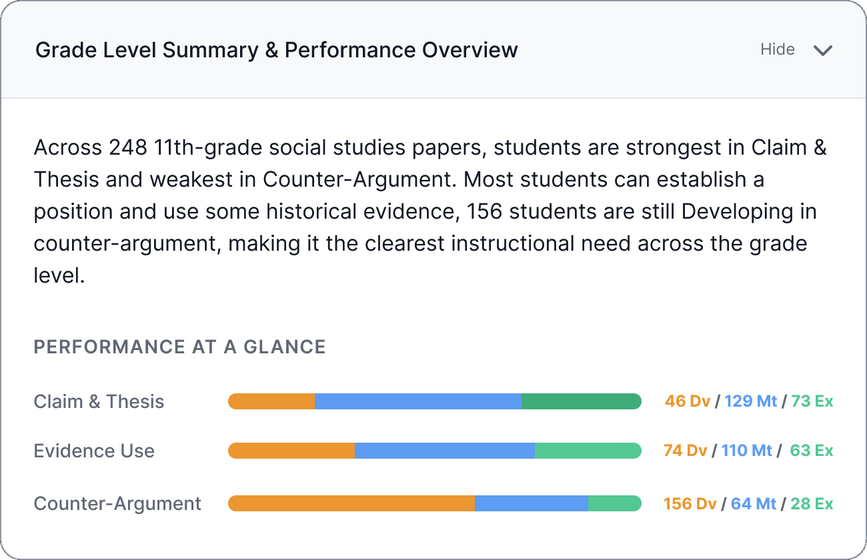
LearningPulse analyzes all 250. Against the criteria your teachers set, per student, per criterion, in minutes. The teacher decides what comes next.
Every student, every criterion, by name.
Teachers set the criteria: their rubric, the department's writing progression, state standards, or a few I-can statements typed in plain language. They confirm the read before anything runs.
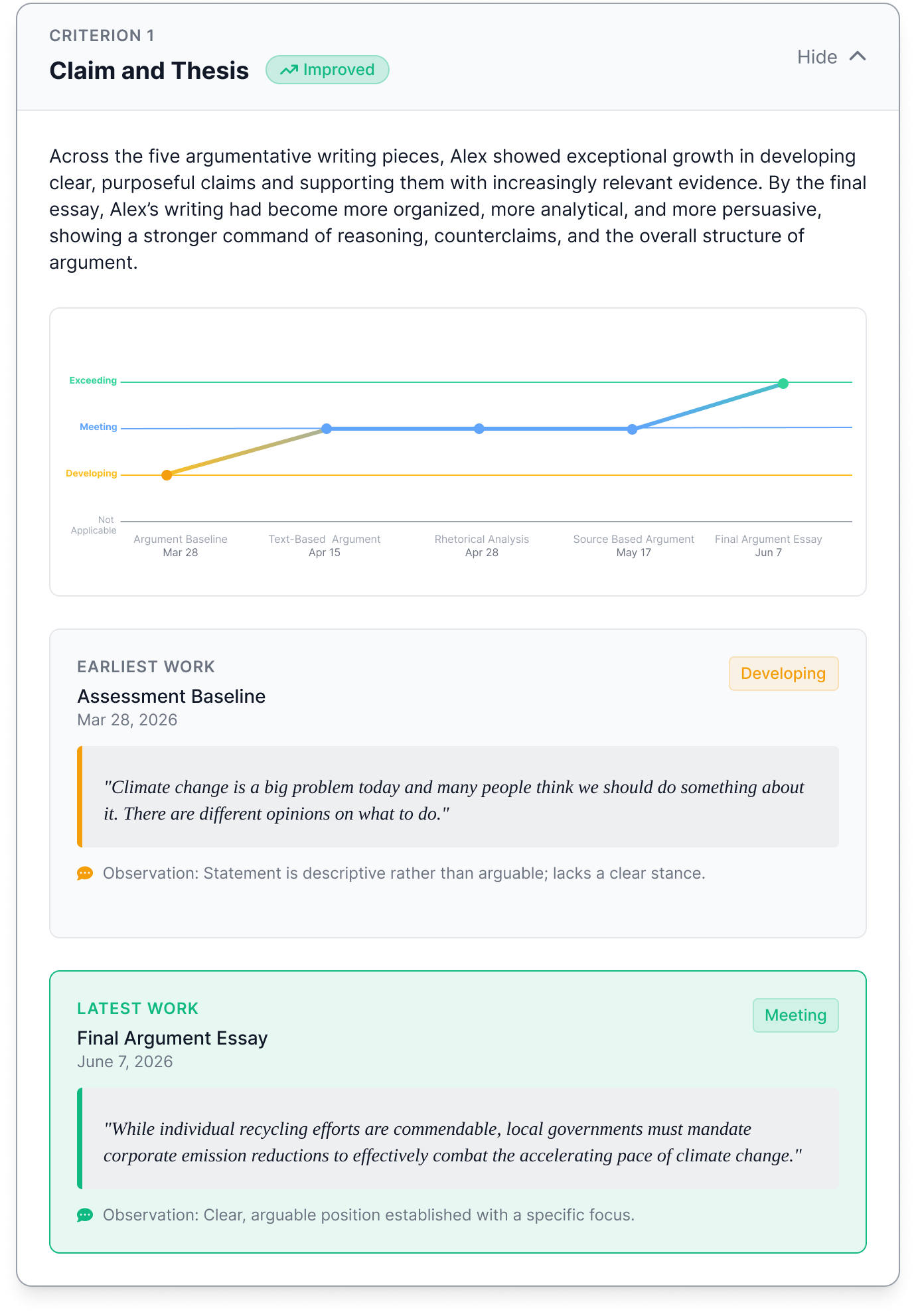
What comes back is the profile an average hides. A student Meeting on claim, Developing on evidence, and Exceeding on reasoning disappears in a stacked bar and is obvious in a matrix. Every placement cites the paper, the quote, and the date, so any claim traces back to the student's own words.

And whether it is actually getting better.
One set of work tells you where students are. Reading the same student against their own earlier work tells you whether the initiative you funded changed what students produce. That is the question a board asks, and it is the one nobody has had the hours to answer.
No new assessment. No new testing window.
It runs on work students already do: a first-week quickwrite, a lab conclusion, a CER response, an essay that was going to be assigned anyway. Handwritten work included, photo or scan. Work comes in from Google Classroom, Canvas, Google Drive, or a drag and drop.
It does not replace your benchmarks. Benchmarks give you a standardized comparison at set moments. This fills the space between them, so you can triangulate: the benchmark, the state data, and the student's actual work. When they disagree, that is the conversation.
Student work is analyzed in a controlled private environment, is never used to train public models, and stays the district's property. A Data Privacy Agreement is signed before any student work is analyzed.
Monday, November 16. 2:00 PM ET.
In 30 minutes, Mike Rutherford, a former classroom teacher and the founder of gotLearning, will run an analysis of all five of one teacher's classes, 24 to 28 papers from each class, against teacher-set criteria, live. Then the view widens to the whole cohort, every class in the PLC at once. If 2:00 doesn't work, register anyway. The recording goes to every registrant.